Media Effects
Videogames & Brain’s Microstructural Properties
Impact of Videogame Play on the Brain’s Microstructural Properties: Cross-Sectional and Longitudinal Analyses" investigates how prolonged videogame play affects brain microstructure and verbal intelligence over time, using advanced imaging techniques.
Molecular Psychiatry · 2016-01-05
Summary
The study aims to understand the neural consequences of frequent videogame play, focusing on its potential negative impacts on verbal intelligence and brain microstructure development.
Key Findings
Increased Mean Diffusivity (MD):
Videogame play was associated with increased MD in several brain regions, including the left frontal cortex, thalamus, and hippocampus.
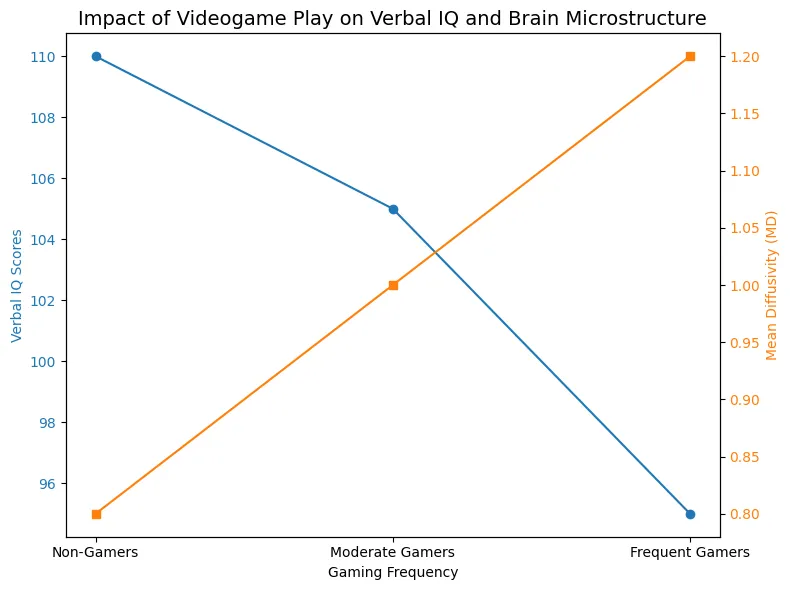
Higher MD in these areas was linked to lower intelligence scores, particularly verbal intelligence.
Negative Impact on Verbal Intelligence:
Both cross-sectional and longitudinal analyses revealed a decline in verbal IQ correlated with prolonged videogame play.
The decline in verbal intelligence persisted over a three-year period.
Changes in Brain Microstructure:
Increased MD was observed in areas involved in memory, motivation, and verbal processing, suggesting delayed neural development.
X-Axis: Categories showing gaming frequency (Non-Gamers, Moderate Gamers, Frequent Gamers).
Left Y-Axis (Blue): Displays Verbal IQ Scores decreasing with higher gaming frequency.
Right Y-Axis (Orange): Displays Mean Diffusivity (MD) values increasing with higher gaming frequency.
Population:
240 participants (114 boys, 126 girls) aged 5.7 to 18.4 years for cross-sectional analysis.
189 participants for longitudinal analysis, with follow-up after 3 years.
Methodology:
Diffusion tensor imaging (DTI) assessed changes in brain microstructure.
Cognitive abilities, including verbal IQ, were measured using standardized intelligence tests.
References:
The study cites 48 references, providing a comprehensive literature review.
Dates:
Data collection occurred from 2012 to 2015.
Implications:
The findings suggest that excessive videogame play may hinder neural development and verbal intelligence. This highlights the need for moderation in gaming and consideration of its potential long-term effects on children's cognitive and brain health.

Built on the same research you're reading.
KidSafeTV — No addictive algorithms, no brainrot. Just approved content that ends calmly.