Parental Guidance
Media and Young Minds: Screen time during ages 0-5
Media and Young Minds" by the American Academy of Pediatrics (AAP) addresses the influence of media on the health and development of children from 0 to 5 years of age, a period of critical brain development, the formation of secure relationships, and the establishment of health behaviors.
AAP · 2016-11-01
Summary
Technological innovation has transformed media and its role in the lives of infants and young children. More children, even in economically challenged households, are using newer digital technologies, such as interactive and mobile media, on a daily basis and continue to be the target of intense marketing. This policy statement addresses the influence of media on the health and development of children from 0 to 5 years of age, a time of critical brain development, building secure relationships, and establishing healthy behaviors.
Key Findings
Infants and Toddlers:
Children younger than 2 years need hands-on exploration and social interaction with trusted caregivers to develop their cognitive, language, motor, and social-emotional skills.
Preschool Media and Learning:
Educational television programs, such as "Sesame Street," have been shown to improve cognitive outcomes and academic readiness for children aged 3 to 5 years.
Health and Developmental Concerns:
Obesity: Excessive media use has been associated with increased risk of obesity in children.
Sleep: Media use, particularly before bedtime, can negatively affect sleep quality and duration.
Child Development: Unsupervised or excessive media use can interfere with the development of language, social skills, and executive function.
Parental Media Use:
Parents' own media use can influence their children's media habits and family interactions.
Recommendations
For Pediatricians:
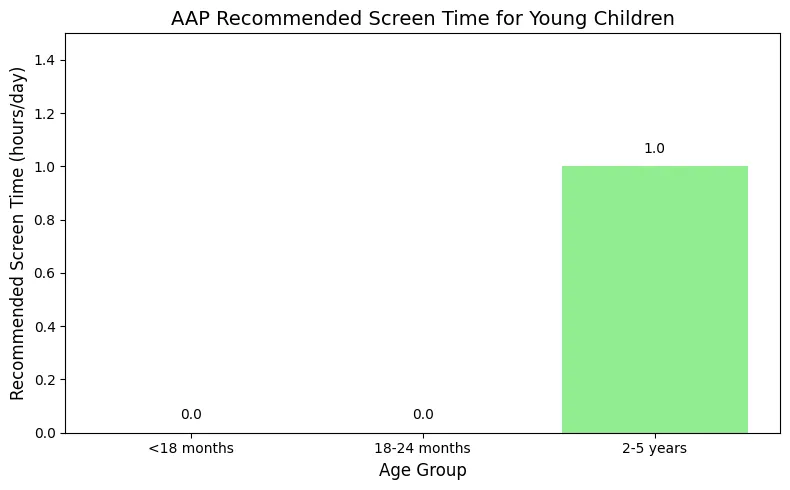
Advise parents to avoid digital media use (except video chatting) in children younger than 18 months.
For children aged 18 to 24 months, if parents wish to introduce digital media, choose high-quality programming/apps and use media together with the child.
For children aged 2 to 5 years, limit screen use to 1 hour per day of responsible programming, co-view with children, and help them understand what they are seeing.
Encourage parents to establish media-free times (e.g., during meals) and locations (e.g., bedrooms) and to model good media use habits.
For Families:
Develop a family media use plan that takes into account the health, education, and entertainment needs of each child and the whole family.
Engage in interactive activities that promote healthy development, such as reading, playing together, and conversing with children.
X-Axis:
Age groups: <18 months, 18-24 months, 2-5 years.
Y-Axis:
Recommended screen time in hours per day.
Implications:
The policy underscores the need for parents and caregivers to be mindful of the quantity and quality of media exposure in young children. By following the AAP's recommendations, families can help ensure that media use supports healthy development and does not interfere with essential activities like sleep, play, and family interactions.

Built on the same research you're reading.
KidSafeTV — No addictive algorithms, no brainrot. Just approved content that ends calmly.