Social Development
Effects of a Social Robot vs. Human Child Interact
Comparing the Effects of a Different Social Partner (Social Robot vs. Human) on Children's Social Referencing in Interaction
Frontiers · 2021-01-14
Summary
This study investigates how children respond to a social robot compared to a human partner in tasks requiring social referencing, such as seeking guidance or approval.
Key Findings
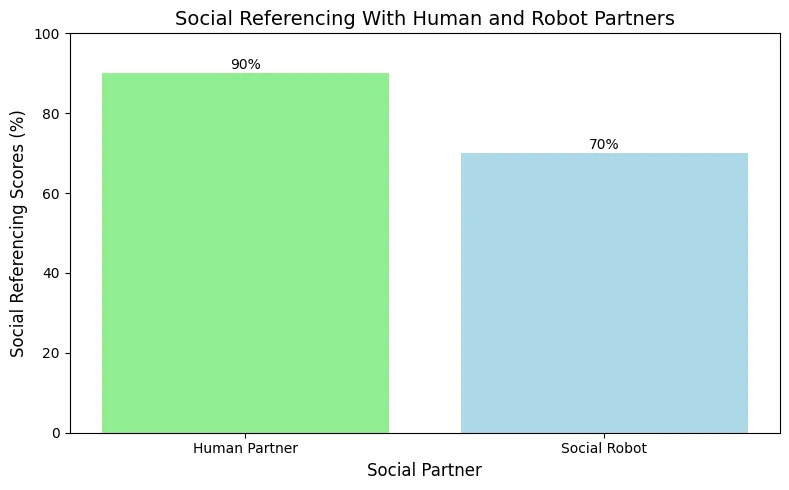
Human Partners Elicit Stronger Responses:
Children relied more on human partners for social cues, especially in ambiguous situations.
Social Robots as Emerging Tools:
While less effective than humans, social robots still prompted significant social referencing behaviors, particularly in structured interactions.
Age Differences:
Older children (6–8 years) engaged more with the robot compared to younger children (4–5 years), possibly due to novelty or better understanding of its capabilities.
The bar chart compares social referencing scores for interactions with a human partner and a social robot, highlighting the stronger engagement with human partners.
Participants: 100 children aged 4–8.
Methodology: Children interacted with a human partner and a social robot in separate sessions. Social referencing was measured based on gaze, gestures, and verbal cues.
Implications Social robots have potential as educational tools but cannot fully replace human interaction in tasks requiring nuanced social understanding.

Built on the same research you're reading.
KidSafeTV — No addictive algorithms, no brainrot. Just approved content that ends calmly.