Learning Outcomes
Learning Between 2D and 3D Sources During Infancy
The study explores how infants learn from two-dimensional (2D) representations, such as videos, and apply this knowledge to three-dimensional (3D) real-world scenarios.
PubMed Central · 2010-06-01
Summary
Infants' ability to transfer learning between 2D and 3D contexts is crucial for their cognitive development. Understanding how these early interactions shape learning can inform educational practices and parental guidance on media usage.
Key Findings
Video Deficit Effect:
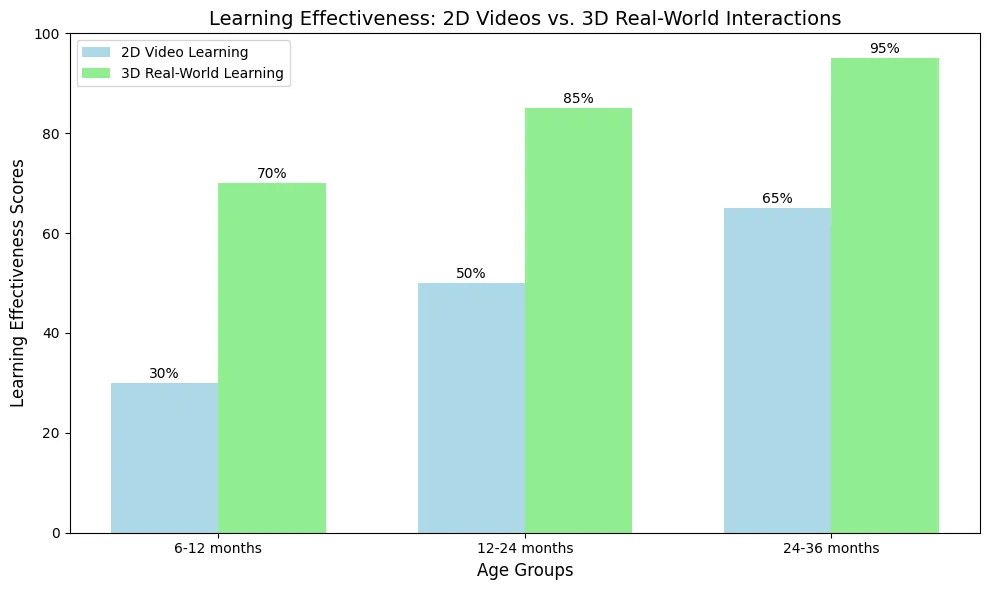
Infants learn less effectively from 2D sources compared to real-world 3D interactions, particularly before 2.5 years of age.
Developmental Trends:
The ability to transfer knowledge from 2D to 3D improves with age, with notable advancements after 2 years.
Enhancing Learning:
Parental engagement, such as co-viewing and pointing out real-world applications of media content, improves infants' ability to bridge the gap between 2D and 3D learning.
X-Axis:
Represents Age Groups of the infants (6-12 months, 12-24 months, and 24-36 months).
This axis categorizes the infants into three developmental stages.
Y-Axis:
Represents Learning Effectiveness Scores (%).
This axis shows the percentage effectiveness of learning in different contexts (2D Videos and 3D Real-World Interactions).
Higher percentages indicate better learning outcomes for the given category.
Population:
Infants aged 6 months to 3 years.
Methodology:
Experimental studies evaluated how infants replicated actions or recognized objects learned from videos and real-world interactions.
Parental engagement was manipulated to assess its impact on learning transfer.
Implications:
The findings emphasize the importance of minimizing passive screen time for infants and encouraging interactive learning environments. Parents can enhance learning transfer by co-viewing media with their children and linking screen content to real-world experiences.

Built on the same research you're reading.
KidSafeTV — No addictive algorithms, no brainrot. Just approved content that ends calmly.